
AQVolt26 Webinar:
Accelerating Solid-State Battery Discovery
with High-Fidelity Data and AI
Date: May 20th, 2026
Time: 10:00 AM PT / 12:00 PM ET
From electric vehicles to grid storage and defense, demand for safer, higher-energy density solid-state batteries is growing faster than traditional R&D can keep up. Yet solid-state electrolytes are notoriously difficult to model: standard DFT workflows are too slow for large-scale dynamics, and existing foundation datasets struggle in the high-temperature, highly distorted regimes where ion transport actually happens in working cells.
In this webinar, SandboxAQ’s battery AI team will introduce AQVolt26 — a 322,656-frame r²SCAN Li-halide dataset and family of universal machine-learning force fields designed to close this high-temperature “blind spot.” You’ll see how AQVolt26 complements datasets like MatPES and MP-ALOE, delivers near-zero failure rates under extreme lattice strain, and enables robust, high-throughput screening of halide electrolytes for next-generation solid-state batteries — moving from prediction → simulation → materials discovery with Large Quantitative Models (LQMs).
Key Learning Objectives
- Understand the modeling gap for solid-state electrolytes – why elevated-temperature, far-from-equilibrium configurations break many existing ML potentials, and how AQVolt26 was designed to systematically cover this regime with r²SCAN-level fidelity.
- See how AQVolt26-powered universal ML force fields behave in practice – including potential energy surface benchmarks, dynamic stability under ±20% lattice deformations, and ionic conductivity predictions that track demanding solid-state electrolyte benchmarks.
- Learn how to incorporate AQVolt26 models into your own workflows – from accessing checkpoints on Hugging Face and interpreting licensing terms, to integrating the potentials into existing MD and materials screening pipelines for battery R&D.
- Explore the roadmap for LQM-driven battery innovation – how AQVolt26 extends SandboxAQ’s earlier work in battery lifetime prediction and lays the foundation for future datasets and models spanning sulfides, cathodes, interfaces, and full solid-state cell design.
About our speakers:

Dr. Omar Allam is a Senior Scientist in the AI Sim Group at SandboxAQ. He holds a Ph.D. in Mechanical Engineering from the Georgia Institute of Technology, where he focused on integrating multiscale atomistic modeling and machine learning for enhancing energy storage and conversion materials. At SandboxAQ, Omar develops AI-enabled computational workflows that bridge quantum mechanics and machine learning to address complex challenges in materials science.
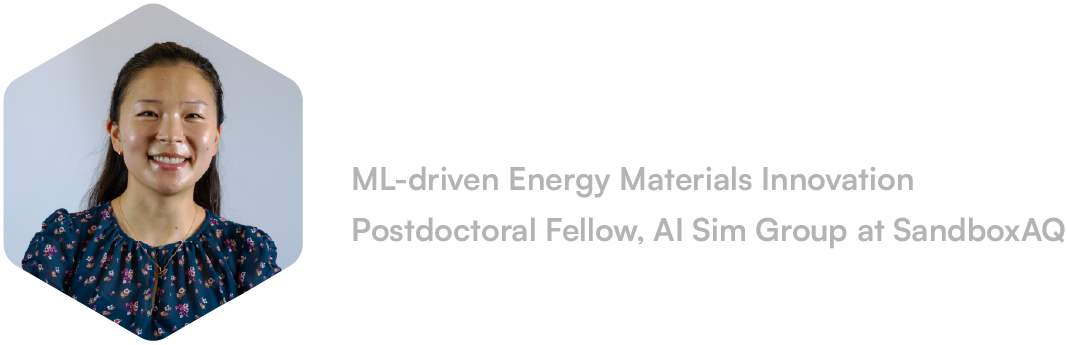
Dr. Jiyoon Kim is an ML-driven Energy Materials Innovation Postdoctoral Fellow in the AI Sim Group at SandboxAQ, where she focuses on next-generation battery materials and AI-enabled energy storage. Trained in materials science and engineering at UC Berkeley with a solid-state battery research background in multivalent cathodes and ion transport, Jiyoon is a lead contributor to SandboxAQ’s AQVolt26 foundation potential and broader Large Quantitative Model workflows for next-generation battery and energy storage discovery.